Astro-Wise Federation
i.
Dataservers
-
handle all files - 99% being image data
-
dataservers know about each other
-
files are store()d
on one local dataserver
-
files are retrieve()d
from the local dataserver
-
if a file is not available locally it is retrieve()d
automatically from one of the other dataservers
-
files that were not locally available are cached to speed up
future access
-
dataservers are implemented in 100% Python
-
dataservers use HTTP protocol including referrals
files can be accessed by URL with any browser or wget (curl).
Current situation
-
single dataservers in use at the different Astro-Wise sites
105,385 files at OmegaCEN
Soon
-
multiple dataservers in use at OmegaCEN
-
dataservers "connected" between Astro-Wise sites
ii. CVS
-
configuration files + source code are handled by CVS
-
central repository
-
local copies / check outs
-
STABLE version
Current situation
-
in use at all Astro-Wise sites - more than 40,000 changes to
odoco, opipe and awhtml.
-
automatic updates
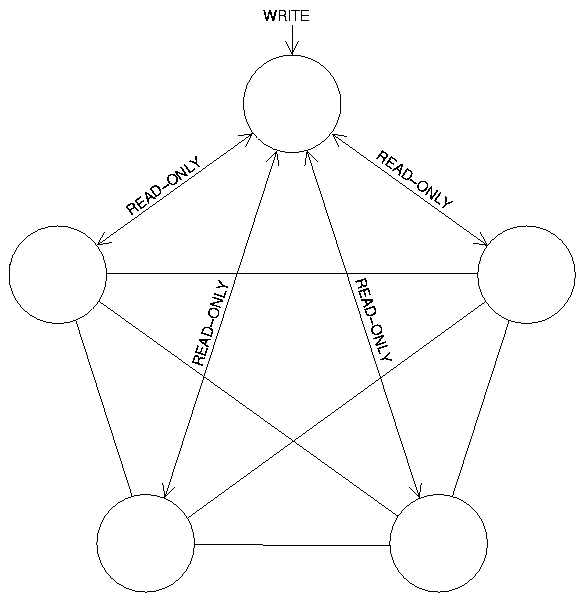
iii.
Database
federation
-
persistent objects are distributed by copying
-
through Oracle Streams
-
using Python layer to access remote tables via database links
-
Copy objects, including identity
-
Copy REFerences
-
Oracle Streams does not support user-defined types
-
valid for all DBObjects i.e.
-
CalFiles
-
METAdata of Raw and (Reduced)ScienceFrames and
CalibrationFrames - such as image statistics
Current situation
-
multi-user databases operational at the Astro-Wise sites
-
Python based table copy being implemented using object identity
Soon
-
federation-wide users
-
per user / context read/write and delete permission
Persistency
Basics
-
Python class
definition also creates DDL
-
Oracle
User-Defined Types are similar to classes
Includes inheritance and methods (PL/SQL, C/C++, Java) and references
to objects
-
Python classes
and attributes are made persistent by inheriting from a persistent base
class
-
Corresponding
Oracle TYPE, TABLE and VIEW are created, if absent
-
Object TABLE
containing objects of exactly one TYPE
-
Object VIEW
contains objects of the TYPE and all its subtypes
-
A `link'
attribute refers to an object. In Oracle a REF is
used
-
Instances are
made persistent with .commit()
-
.commit() works recursively
-
Objects can be
retrieved by object_id or
with a Python query
similar to Conceptual Queries
-
Python queries
are Select objects
-
A Select object can be a logical combination of Select
objects
-
Select objects are transformed
into SQL not earlier than necessary
-
Select object provides an
iterator that returns Python objects
class BiasFrame(BaseFrame):
instrument =
persistent('', Instrument, None)
chip
= persistent('', Chip, None)
observing_block = persistent('', ObservingBlock,
None)
timestamp_start = persistent('',
DateTime.DateTimeType, DateTime.DateTime(1990,1,1))
timestamp_end = persistent('',
DateTime.DateTimeType, DateTime.DateTime(2030,1,1))
creation_date = persistent('',
DateTime.DateTimeType, DateTime.DateTime(1990,1,1))
raw_bias_frames = persistent('The frames used to
construct this frame', RawBiasFrame, [])
process_params = persistent('Processing
parameters', BiasFrameParameters, None)
prev
= persistent('Comparison frame')
CREATE TYPE "BiasFrame$"
UNDER "BaseFrame$"
(
"raw_bias_frames" "BiasFrame$raw_bias_frames",
"instrument" REF "Instrument$",
"timestamp_start" DATE,
"prev" REF "BiasFrame$",
"observing_block" REF "ObservingBlock$",
"chip" REF "Chip$","timestamp_end" DATE,
"process_params" REF "BiasFrameParameters$",
"creation_date" DATE
)
NOT FINAL
;
CREATE TABLE "BiasFrame"
OF "BiasFrame$"
NOT SUBSTITUTABLE AT ALL LEVELS
NESTED TABLE
"raw_bias_frames"
STORE AS "BiasFrame-raw_bias_frames"
;
CREATE VIEW "BiasFrame+"
OF "BiasFrame$"
UNDER "BaseFrame+"
AS
SELECT *
FROM "BiasFrame"
WITH READ ONLY
;
for flat in
(TwilightFlatFrame.chip.name == 'A5506-4') &
(TwilightFlatFrame.creation_date > DateTime.DateTime(2003,11,31)):
print flat.filename, flat.bias.filename
flat.retrieve()
flat.bias.retrieve()
Scalability
-
Partitioned tables and indexes
Logically and physically divide large tables into
partitions/tablespaces
-
Tables and indexes can be partitioned independently
-
Range, hash,
list partitioning
-
Partitioning
can be changed in a running database
-
Nested tables
cannot be partitioned
Locally, a
client-server architecture of Oracle is deployed. awe clients connect
to the local database via the network.
Different servers
communicate with each other (OAC, USM , Terapix etc) via iii) and i).
Servers exchange
the METAdata / DBObjects, but not
the files. Files are handled by the dataserver.